 By
London-based NGO Equidem has published a report finding labour rights violations persisted in all eight Qatar World Cup stadiums despite Qatari labour reforms, according to the Business & Human Rights Resource Centre. The violations included confiscation of workers’ passports, physical and mental abuse, health and safety violations, deaths, discrimination, and non-payment of wages.
The report, published less than a month before the 2022 Qatar World Cup, drew on testimonies from around 1,000 workers at the stadiums, with 60 workers given one-on-one in-depth interviews. Equidem named 18 World Cup stadium contractors. FIFA said it was cooperating with Qatari counterparts to assess the findings, as reported by Rolling Stone magazine.
What the Equidem findings mean for payroll teams in Qatar
The non-payment of wages allegation carries direct implications for payroll and HR practitioners operating in Qatar. Under Qatar’s Wage Protection System (WPS), employers must pay salaries through approved financial institutions, and the Ministry of Labour monitors compliance. When contractors fail to pay wages, the liability picture becomes complex: main contractors, subcontractors, and labour supply companies may all sit in the payment chain.
For payroll leads, the practical question is whether their organisation has visibility into how subcontractor wages are actually disbursed. The Equidem report names contractors including HBK Contracting Company, Galfar Al Misnad, Pigeon Engineering, Al Jaber Engineering, Midmac, Larsen & Toubro, and Six Construct Qatar. HR teams with any indirect exposure to these firms, through joint ventures, supply chains, or facility management contracts, should review payment verification processes.
Recruitment fees and passport retention: the compliance gaps
Equidem reported that 100% of the 60 workers interviewed in depth said they paid illegal recruitment fees. Almost half reported nationality-based discrimination. These findings point to practices that sit upstream of payroll but create downstream liability.
Qatar’s Law No. 21 of 2015 regulates the entry and exit of expatriate workers and prohibits employers from retaining passports without the worker’s written consent. In practice, enforcement has been uneven. HR teams should verify that any recruitment agencies used in Qatar provide auditable evidence that workers were not charged fees. Where fees are discovered, remediation typically involves reimbursement and contract correction, not simply a policy update.
The discrimination finding also matters for payroll classification. Nationality-based pay differentials, where workers from certain countries receive lower wages for equivalent roles, can create legal exposure under Qatar’s anti-discrimination provisions and under client codes of conduct.
Contractor accountability and what HR can verify
The Supreme Committee for Delivery and Legacy told Equidem that its standards ensure “substandard contractors are eliminated at the earliest possible stage of the process” and that construction companies are “subjected to ongoing due diligence.” The committee also said its systems “have at times been exploited by bad-faith contractors.”
Only four of the 18 named contractors responded to Equidem: Advanced Construction Technology Services, Al Sulaiteen Agricultural & Industrial Complex, Galfar Al Misnad, and WeBuild. Seven responded to the Resource Centre: Besix, SAIC, Salfo Engineering and Management, IMAR, Land Worx, WeBuild, and Galfar Al Misnad.
For HR and compliance teams, the low response rate itself is a signal. Organisations that rely on contractor self-certification should consider independent verification of wage payments, accommodation standards, and passport custody. A practical step is to require subcontractors to submit WPS payment reports for all workers on a project, not just direct employees.
What the report does not resolve
The Equidem report documents violations but does not establish which specific contractors committed which specific violations. The named companies span security services, engineering, agriculture, and construction. Some, such as Regency Security Services and Al Sraiya Security Services, provide outsourced staff rather than construction labour, which raises questions about how security personnel were included in stadium worker testimonies.
The Resource Centre was unable to contact J&P to invite a response. No response was received from Advanced Construction Technology Services, Al Sraiya Security Services, Pigeon Engineering, Al Jaber Engineering, Midmac, Larsen & Toubro, Al Jaber Trading & Contracting, Gulf Contracting, Regency Security Services, HBK Engineering, or HBK Contracting.
Practical steps for HR and payroll leads in Qatar
Organisations with operations or supply chain exposure in Qatar should treat the Equidem report as a due diligence trigger rather than a definitive finding against any single employer. Concrete steps include mapping all subcontractors against the 18 named firms, requesting WPS payment evidence for the past 12 months, and reviewing recruitment agency contracts for fee clauses.
Where violations are found, remediation should follow Qatar’s Ministry of Labour procedures. Payroll teams should also confirm that end-of-service benefits are calculated correctly, since underpayment of final settlements is a common companion to wage non-payment.
Sources: Business & Human Rights Resource Centre
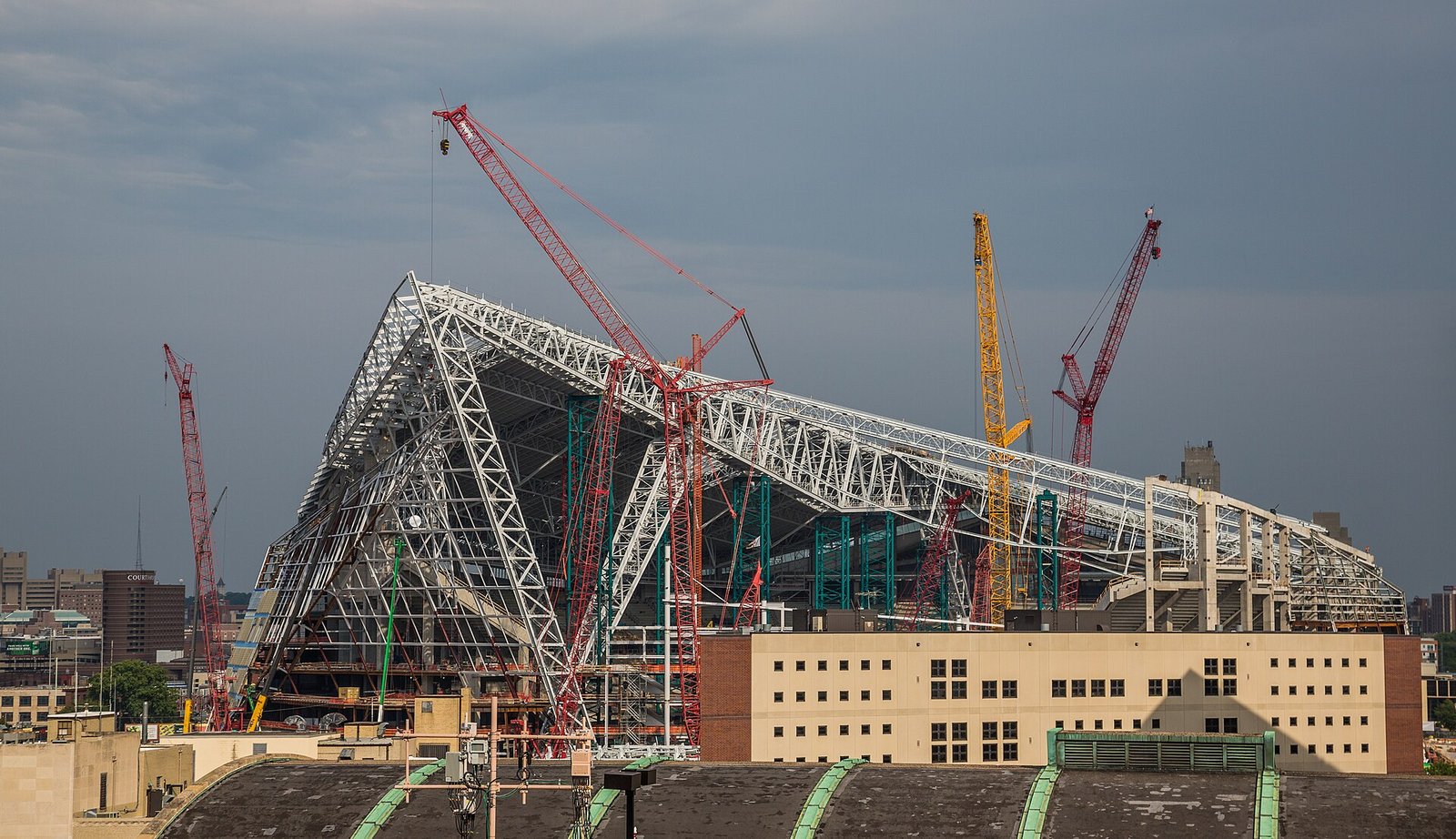
Photo: US Bank Minnesota Vikings Stadium Construction Minneapolis 19731972706 by Tony Webster, CC BY 2.0