 By
A migrant worker who spent 16 years in Singapore’s marine industry has lost his work permit renewal after posting a video calling for a S$2,000 minimum wage for every worker in Singapore, locals included. The Ministry of Manpower told his employer on 1 October that he was no longer eligible for renewal, according to Startup Fortune, which first reported the case. The video was posted on 20 September and his current permit runs out on 21 November.
The worker says he does not know the reason for the refusal and no public reason has been given. Startup Fortune found no statement from MOM on the case. The outlet notes that a refused renewal is not the same as the revocation claimed in a Reddit thread title about the incident, which read: “Migrant worker who demanded 2K per month minimum wage is no longer allowed to work in Singapore after MOM revoked his WP.” The r/asksg thread drew 760 upvotes and 934 comments.
What Singapore’s wage rules actually cover
Singapore has no general minimum wage. The Progressive Wage Model sets pay ladders for selected sectors such as cleaning, security and landscaping, but according to the sources Startup Fortune reviewed, it covers citizens and permanent residents, not work permit holders. That distinction matters for payroll teams: a Singaporean cleaner and a work permit holder doing similar work can be paid under different frameworks.
For HR and payroll leads, the practical point is that work permit holders are typically paid according to the employment contract and any sector-specific requirements, not the PWM. Employers should not assume that a PWM wage floor applies to every worker on site. The Ministry of Manpower publishes sectoral schedules, and payroll teams should confirm which workers fall under which scheme before processing pay runs.
The cost structure behind the debate
Commenters in the Reddit thread laid out what a construction firm pays per worker, though Startup Fortune states these are commenters’ figures and they have not checked them. The breakdown included a basic wage of S$500 to S$700, overtime, a levy of up to S$900, lodging of about S$350 to S$400 and insurance, which those commenters put at roughly S$1,800 to S$2,300 a month in total employer cost.
Those figures, if accurate, show why a S$2,000 basic wage would be a significant shift. The total cost per worker would rise well above current levels once levy, lodging and insurance are added. Commenters on that side concluded that a S$2,000 wage would push up the price of homes, rents and everything else. Others countered that most Singapore businesses earn from suppressing wages, and that the only way anyone bargains for higher pay is together.

What the permit refusal means for employers
MOM has said in earlier cases that foreigners have no automatic right to work in Singapore. Startup Fortune calls that true and says it is the heart of the problem. For employers, this means a work permit renewal is never guaranteed, even for a worker with 16 years of service. The refusal in this case came after the worker’s public advocacy, but permits can be refused for many causes, and several commenters guessed it was the activism, not the wage demand, that triggered the decision.
HR teams should treat any public political or policy advocacy by a work permit holder as a potential risk factor, not because it is prohibited, but because the renewal process gives MOM broad discretion and no reason is required. The practical step is to plan for the possibility that a renewal may be refused and to have succession or replacement plans ready, especially for long-serving workers in hard-to-fill roles.
The wider debate on migrant worker rights
The Reddit discussion split sharply. The most upvoted reply, close to 200 votes, asked what is wrong with fighting for better pay for himself and his peers, and warned that cheering his removal means backing pro-business policy against your own wages. Another comment with almost as many votes said most Singapore businesses earn from suppressing wages. A third, near 150 votes, called it ironic that residents campaign against better conditions for foreign workers without seeing that they share more with those workers than with their employers.
One commenter argued that Singaporeans’ immigrant ancestors were coolies to the towkays and the colonial masters, and that today’s migrant workers are closer to that lineage than the wealthy imports who get citizenship on easy terms. Startup Fortune makes a similar point, noting that much of Singapore’s Chinese majority descends from labourers who came in the British colonial era, and that the British set up the Chinese Protectorate in 1877 because those workers were being badly treated.
On the other side, commenters said it is a free market, someone else will take the job, and that foreigners should not lecture Singapore about its policies. The line that kept returning was: “Don’t forget you’re a guest.” One commenter described a former site supervisor who spent a decade in Singapore, bought a house and built a small clinic back home, as proof the pay is already life-changing.
What happens next
The worker’s current permit runs out on 21 November. No public reason has been given, and no MOM statement on this case was found. The worker said he wanted a fair system for Singaporeans and migrants together, not special treatment for foreigners. Startup Fortune’s stated view is that “a society that treats a wage request as disloyalty is going backwards.”
For HR and payroll readers, the case is a reminder that wage policy in Singapore remains politically sensitive and that work permit renewals carry uncertainty that no employment contract can fully offset. Employers with long-serving work permit holders should review their workforce plans now, before the November expiry, and confirm with MOM or a licensed employment agent whether any sector-specific wage rules apply to their workers.
Sources: Startup Fortune
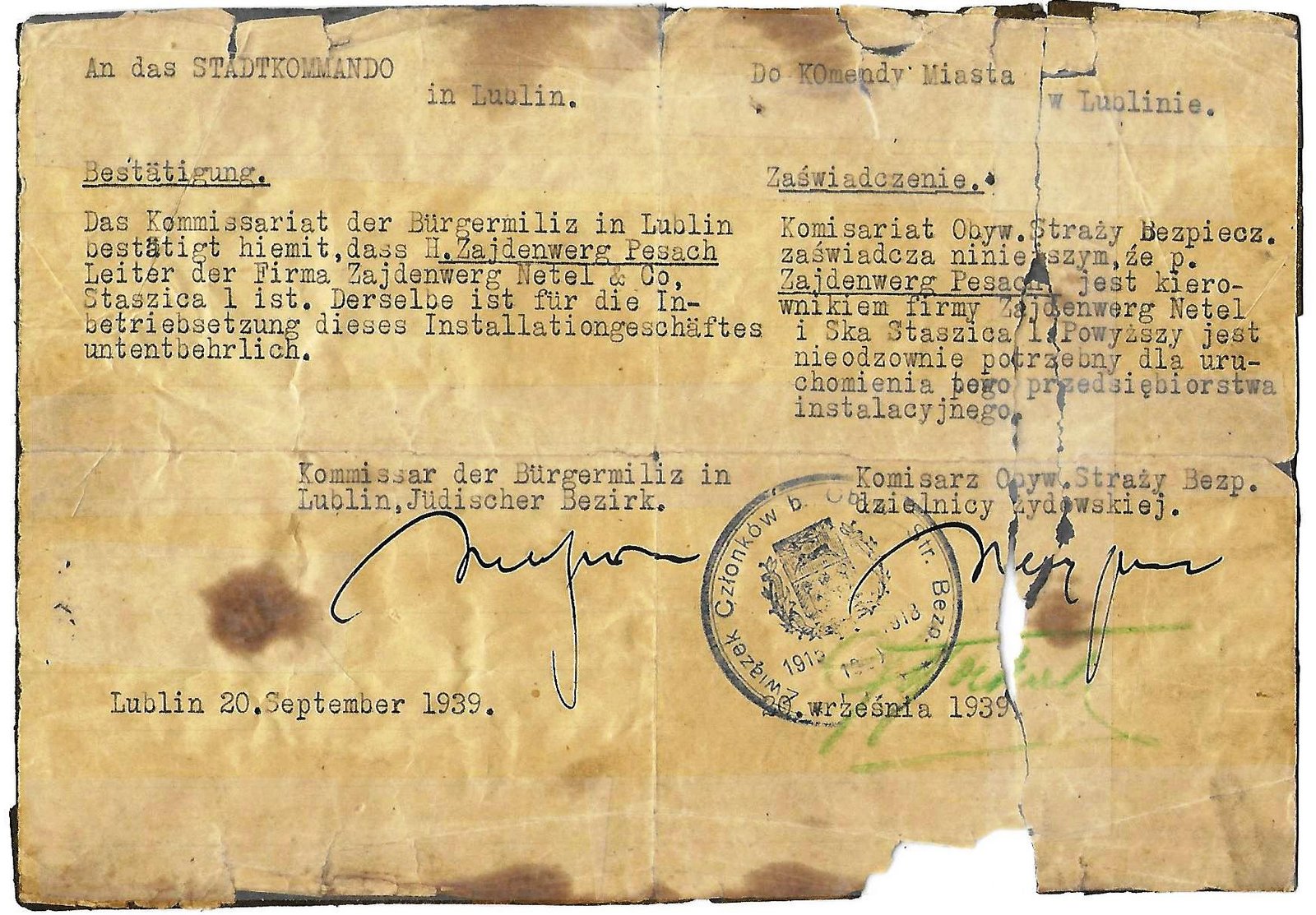
Photo: 1939 very early German issued Jewish work permit from Lublin by Huddyhuddy, Public domain