 By
The Government of Japan and the International Labour Organization have signed a two-year agreement to help displaced persons from Myanmar access and retain decent work in Thailand, according to the ILO. The project, titled “Strengthening Employment Support System for Displaced Persons from Myanmar,” is funded by the Japan International Cooperation Agency with 478 million yen.
The signing took place in Bangkok on 17 November 2026. Ambassador Masato Otaka of Japan, ILO Country Office Director Xiaoyan Qian, and JICA Thailand Chief Representative Shunsuke Sakudo signed the agreement. The project follows a Royal Thai Government Cabinet Resolution adopted on 26 August 2025 that opened a legal pathway to employment for displaced persons in designated provinces.
What the project will do in practice
The project has concrete targets. It will provide pre-employment training for 4,500 displaced persons and their family members, train trainers within the shelters, and strengthen job-matching services in shelters and district offices. Activities cover four shelter-hosting provinces: Tak, Mae Hong Son, Kanchanaburi and Ratchaburi.
Employer engagement will focus on Chonburi, Rayong and Kanchanaburi, including outreach to Japanese companies and their supply chains. Labour protection, grievance mechanisms and follow-up support will be available wherever the displaced persons work. The ILO will implement the project with the Ministry of Labour and in close cooperation with UNHCR.
Ambassador Otaka said the Royal Thai Government’s decision to allow displaced persons from Myanmar to work outside temporary shelters is “a timely and highly commendable initiative.” Ms Qian said the project “will help displaced persons access safe and decent jobs, while supporting employers to meet their labour needs.”
Why Thailand opened a legal work pathway
Thailand has hosted people fleeing conflict and persecution in Myanmar for more than four decades. Approximately 77,000 people currently live in nine temporary shelters along the Thailand-Myanmar border. Until recently, displaced persons relied heavily on humanitarian assistance and had no formal route into the Thai labour market.
The Cabinet Resolution of 26 August 2025 changed that. It opened a legal pathway to employment amid declining humanitarian funding and labour shortages in Thailand. A growing number of displaced persons have since found jobs, according to the ILO. The policy is known as the Royal Thai Government’s ‘Right to Work’ policy for displaced persons from Myanmar.

What this means for HR and payroll teams
For employers in Thailand, the project signals that hiring displaced workers from Myanmar is becoming a structured, supported process rather than an informal arrangement. HR teams in Chonburi, Rayong and Kanchanaburi, where employer engagement will concentrate, may see more candidates from the shelter system entering recruitment pipelines.
The ILO identifies remaining barriers that HR teams should plan for: language barriers, limited work experience and risks of exploitation. Employers need support to recruit and integrate displaced workers effectively. The project’s job-matching services and pre-employment training are designed to reduce those frictions before candidates reach an employer.
Payroll teams should note that the legal basis for employment is the Cabinet Resolution and the ‘Right to Work’ policy, not a standard work permit route. Employers should confirm with the Ministry of Labour how to document the employment status of displaced workers correctly for payroll, social security and tax withholding purposes. The ILO’s project does not change Thai payroll law; it adds support services around recruitment and retention.
Practical steps for employers
Employers interested in hiring displaced workers from Myanmar can start by contacting the Ministry of Labour or the ILO country office in Bangkok to understand where job-matching services will operate. The project will strengthen matching in shelters and district offices in Tak, Mae Hong Son, Kanchanaburi and Ratchaburi, so recruitment channels will run through those locations even when the workplace is elsewhere.
Japanese companies and their supply chains are a specific outreach target. Businesses in manufacturing or export sectors in Chonburi and Rayong may be approached directly as the project expands employer engagement. HR teams should prepare onboarding materials that account for language differences and limited prior work experience, two barriers the ILO names explicitly.
The project will also develop policy recommendations to sustain results beyond the two-year term. Employers should monitor those recommendations, as they may shape future rules on work authorisation, protection standards or employer obligations.
| Province | Project role |
|---|---|
| Tak | Shelter-hosting, training and job-matching |
| Mae Hong Son | Shelter-hosting, training and job-matching |
| Kanchanaburi | Shelter-hosting plus employer engagement focus |
| Ratchaburi | Shelter-hosting, training and job-matching |
| Chonburi | Employer engagement focus |
| Rayong | Employer engagement focus |
What remains unclear
The ILO announcement does not specify which industries will be targeted for employer outreach, nor does it detail the grievance mechanism’s structure or how it will interact with existing Thai labour inspection. It also does not state whether the pre-employment training will produce recognised certificates that employers can use for compliance purposes. HR teams should ask the Ministry of Labour or ILO directly about documentation requirements before onboarding displaced workers.
Sources: International Labour Organization
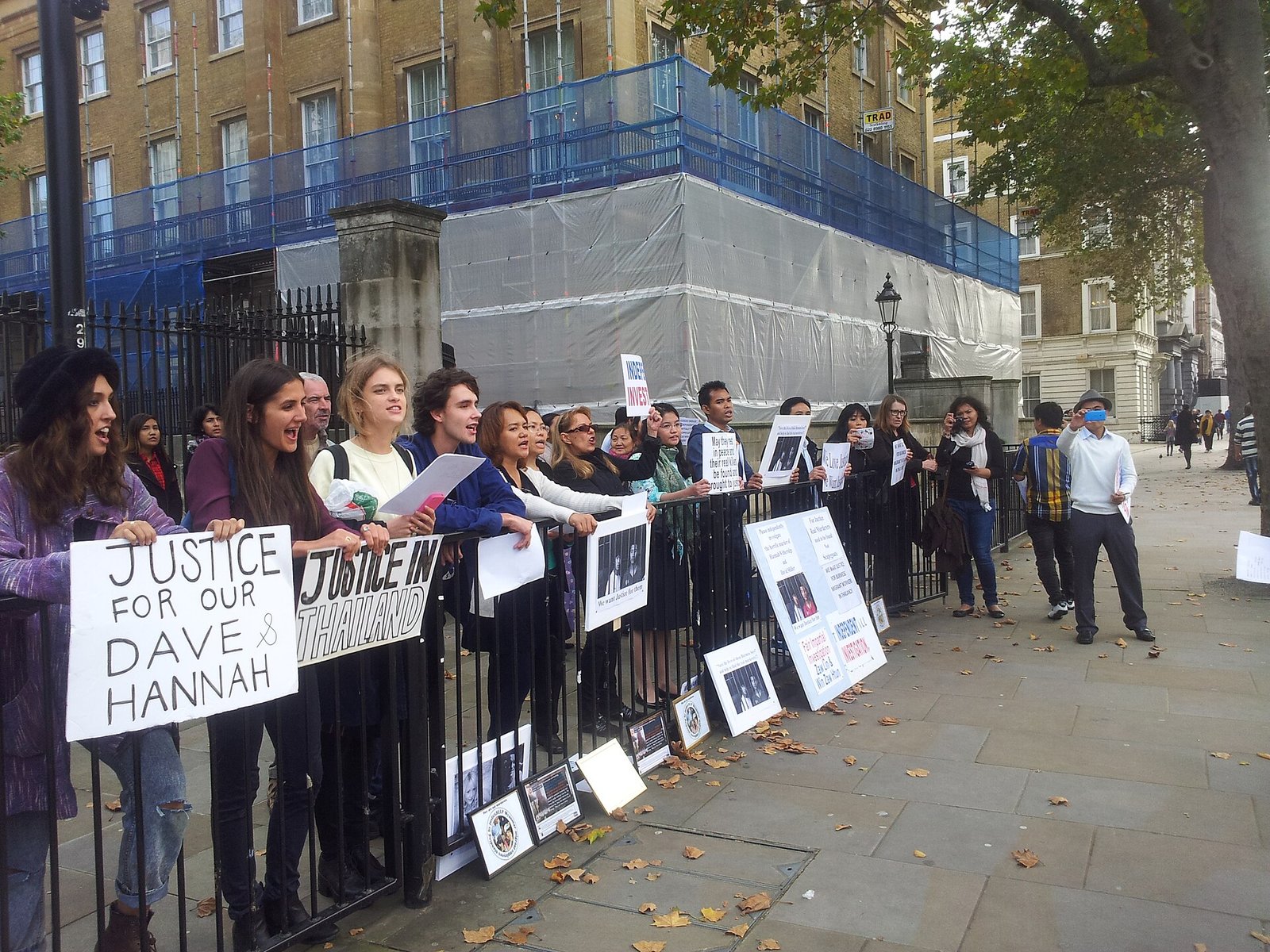
Photo: Burmese demanding justice for Burmese migrant workers in Thailand (15429261898) by Burma Democratic Concern (BDC) from United Kingdom, CC BY 2.0