 By
Infosys added 4,480 employees in the July to September quarter of FY27, taking its total workforce to 3,32,542 at the end of September, compared with 3,28,062 at the end of June, according to ETHRWorld. Voluntary attrition in IT services declined to 12.7 percent from 13 percent in the preceding quarter.
The results, published on 23 October 2026, also showed a 6.2 percent year-on-year increase in consolidated net profit to Rs 7,823 crore, while revenue rose 10.7 percent to Rs 49,244 crore. CEO Salil Parekh had earlier indicated that the company hired more than 4,000 graduates in the June quarter and that most employees would receive salary hikes in October, with senior employees receiving them in January.
What the headcount addition actually signals
The net addition of 4,480 employees is modest by Infosys’s historical standards but marks a continuation of positive hiring momentum. The company has said it plans to recruit 20,000 fresh graduates in FY27, which means the first half of the fiscal year has already absorbed a significant portion of that target. For HR teams inside Infosys and across the Indian IT sector, the more telling figure is the direction of attrition.
Attrition falling from 13 percent to 12.7 percent quarter-on-quarter suggests that the post-pandemic churn cycle has stabilised. Indian IT services companies typically report attrition on a last twelve months basis for their IT services segment, not as a quarterly annualised figure. That distinction matters for payroll and workforce planning teams because a trailing twelve month number responds slowly to current conditions. A single quarter of lower exits does not immediately reset the twelve month average, so the 0.3 percentage point decline indicates that exits have been moderating for several months, not just in Q2.
Why the salary hike timing matters for retention
Infosys has confirmed that salary increases will be rolled out in phases in October 2026 and January 2027. Most employees are expected to receive hikes in October, while senior employees will receive them in January. This staggered approach has become common across Indian IT employers, but it creates a retention risk window.
Employees who know their increment is coming in October may delay a job switch until the revised salary is reflected in their payslip, since a higher current salary strengthens their negotiating position with a new employer. The January cohort, typically senior managers and above, faces a longer wait. HR teams in competitor firms often time lateral hiring campaigns to exploit this gap, targeting senior Infosys employees between October and January when their increments are still pending.
For payroll administrators, the phased rollout means two separate revision cycles within one fiscal year. Each phase requires updated compensation letters, revised tax projections under India’s income tax regime, and adjustments to provident fund contributions where basic pay changes. Employers should confirm the exact treatment of variable pay and bonuses against the revised base for their own payroll systems.

How Infosys compares with the broader IT hiring market
The Indian IT services industry remains a bellwether for white collar employment in the country. Infosys, TCS, Wipro, HCLTech and others collectively employ millions of professionals, and their quarterly headcount changes are watched closely by the Ministry of Labour and Employment, NASSCOM and state governments that host large technology parks.
Infosys’s attrition of 12.7 percent is below the elevated levels seen during the 2021 to 2022 attrition spike, when several large Indian IT firms reported rates above 20 percent. The People Also Ask data from Economic Times shows readers still ask whether 20 percent attrition is high, which reflects lingering memory of that period. At 12.7 percent, Infosys is closer to what industry observers consider a manageable band for large Indian IT employers, though still above the single digit rates that prevailed before the pandemic.
The fresher hiring commitment of 20,000 for FY27 is significant for campus recruitment teams and for engineering colleges across India. It signals that Infosys expects sustained demand for delivery capacity even as automation and AI tools reduce some routine work. The company hired more than 4,000 graduates in the June quarter alone, which means fresher onboarding is running ahead of the pace needed to hit the annual target if spread evenly.
What HR and payroll leaders should watch next
The next two quarters will test whether Infosys can hold attrition below 13 percent while rolling out salary increases. A common pattern in Indian IT is for attrition to tick up in the quarter after increments are paid, as employees who were waiting for their revised salary complete their job searches. If Infosys reports attrition at or below 12.7 percent in Q3 FY27, it would be a stronger signal of genuine retention improvement.
Payroll teams should also monitor the January 2027 senior employee increment cycle. Senior exits have a disproportionate impact on delivery continuity and client relationships, so retention data for that cohort will matter more than the headline attrition number.
The revenue growth of 10.7 percent year-on-year, combined with headcount growth of roughly 1.4 percent quarter-on-quarter, suggests Infosys is improving revenue per employee. That metric is closely watched by investors but also has implications for compensation budgets. If productivity gains continue, there may be room for stronger variable payouts in subsequent quarters, which would further support retention.
For HR managers across the Indian IT sector, Infosys’s Q2 numbers provide a benchmark. Attrition in the 12 to 13 percent range, fresher hiring at scale, and phased increments are now the operating norms for large players. Smaller IT services firms and captives may need to match the increment timing or offer counter-offers earlier in the cycle to remain competitive.
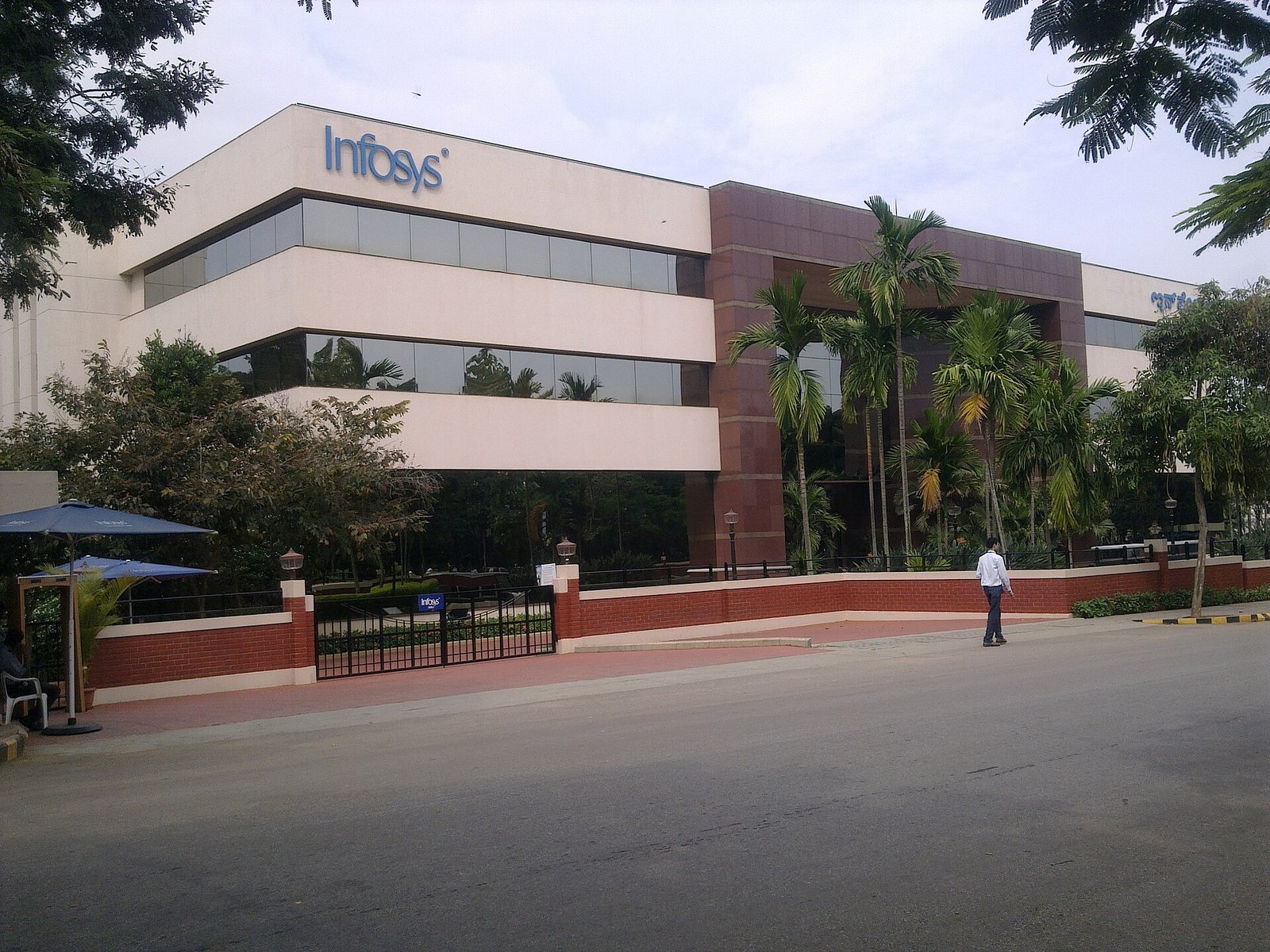
Photo: Infosys Limited Corporate Head Office by PrasanthR, CC BY-SA 3.0