 By
A Qatari lawyer has set out what employers must do when monthly wages fall due, and what workers can do when the money does not arrive. In an opinion column published by Qatar Tribune on 1 November 2026, Faysel Al-Mohannadi, a lawyer admitted before the Court of Cassation, explained that since 8 September 2026 a monthly wage falls due on the first day of each calendar month.
The employer then has seven days to transfer the wage through the Wage Protection System, the Ministry of Labour’s system for tracking salary payments into workers’ bank accounts. Once the seventh day passes with no transfer, the employer is in breach. The governing instrument is Ministerial Decision No. 4 of 2015, as amended in 2026.
What the law requires of employers
The column points to two articles of Qatar’s Labour Law that define lawful payment. Article 66 states that wages must be paid in Qatari riyals by transfer to the worker’s account with a bank in Qatar, and only that transfer counts as payment. Cash payments, partial payments outside the system, or promises to pay later do not satisfy the rule.
Article 70 adds that an employer may not stop or hold back a wage except to carry out a court judgment. That means deductions for alleged damage, lost property or performance issues are not permitted without a court order. For HR and payroll teams, the practical reading is straightforward: the Wage Protection System transfer is the only evidence that matters, and the seven-day window is the compliance deadline.
The penalty for breaching the payment rule is up to one year in prison, a fine of QAR 2,000 to 10,000, or both. The Ministry of Labour can also stop issuing new work permits to the company until arrears are paid. For a growing business, that second sanction can be more damaging than the fine, since it blocks hiring.
What happens when a worker complains
A wage dispute in Qatar goes through two stages. The worker first files a complaint with the Ministry of Labour, online or at its offices. The Ministry hotline is 16505 or 44068979. The Ministry tries to reach a settlement within seven days.
If no settlement is reached, the case is referred to the Labour Dispute Settlement Committee, which is chaired by a judge. The first hearing must take place no later than seven working days after referral. The committee must then decide within three weeks of that hearing. Workers’ claims are exempt from court fees, but any document not in Arabic needs a certified Arabic translation.
One point that stands out for employers is enforcement. The committee’s decision can be enforced as soon as it is issued, even if the employer appeals. Either side has fifteen days to appeal to the Court of Appeal, but an appeal does not stop enforcement unless the Court of Appeal orders it. If the employer still does not pay, the decision is enforced through the Enforcement Court.
The Workers’ Support and Insurance Fund
If the employer cannot pay, the Workers’ Support and Insurance Fund pays dues awarded by the committee, within limits. The Fund covers up to three months’ gross salary, capped at QAR 20,000, if the company is still operating. Lower caps apply for dissolved companies and for domestic workers. The Fund then recovers the money from the employer.
There is a trap for workers that HR teams should also understand. The Fund closes a request if the worker has signed a written settlement with the employer, even one that was never honoured. That means a worker who signs a clearance or receipt for dues before the money is actually in the account can lose access to the Fund. The column advises workers not to sign a clearance or receipt until the money is in the account.
Deadlines and practical steps
Claims lapse one year after the contract ends, under Article 10. Filing with the Ministry pauses that clock while the settlement stage runs. The column advises workers to act early and in order: document, ask in writing, complain, and keep the deadline in view.
The steps set out are practical. Workers should check bank statements, note each month missed or paid short, ask the employer or HR for the wage in writing by email or message, keep any reply, and keep the contract, payslips and messages. Two cautions stand out. Workers should keep working unless advised otherwise, because being absent without a valid reason for more than seven days in a row is a ground for dismissal without gratuity under Article 61. And workers should not sign a clearance or receipt for dues until the money is actually in the account.
Labour Law Article 146 bis, added in this year’s amendments, gives a worker who is not paid the right to apply to change employer or to end the contract, with the employer paying the journey home. That creates a second risk for non-paying employers beyond fines and permit blocks: losing staff who are legally entitled to leave.
| Stage | Timeframe | Authority |
|---|---|---|
| Wage due | First day of each calendar month | Ministerial Decision No. 4 of 2015, as amended 2026 |
| Payment window | Seven days from due date | Wage Protection System |
| Ministry settlement attempt | Within seven days of complaint | Ministry of Labour |
| First committee hearing | No later than seven working days after referral | Labour Dispute Settlement Committee |
| Committee decision | Within three weeks of first hearing | Labour Dispute Settlement Committee |
| Appeal window | Fifteen days | Court of Appeal |
| Claim lapse | One year after contract ends | Article 10 |
The column’s author notes that the information is general and not advice on any particular case. HR and payroll teams in Qatar should treat the seven-day window as a hard operational deadline, not a target, and should confirm the current rules with the Ministry of Labour for their own situation.
Sources: Qatar Tribune
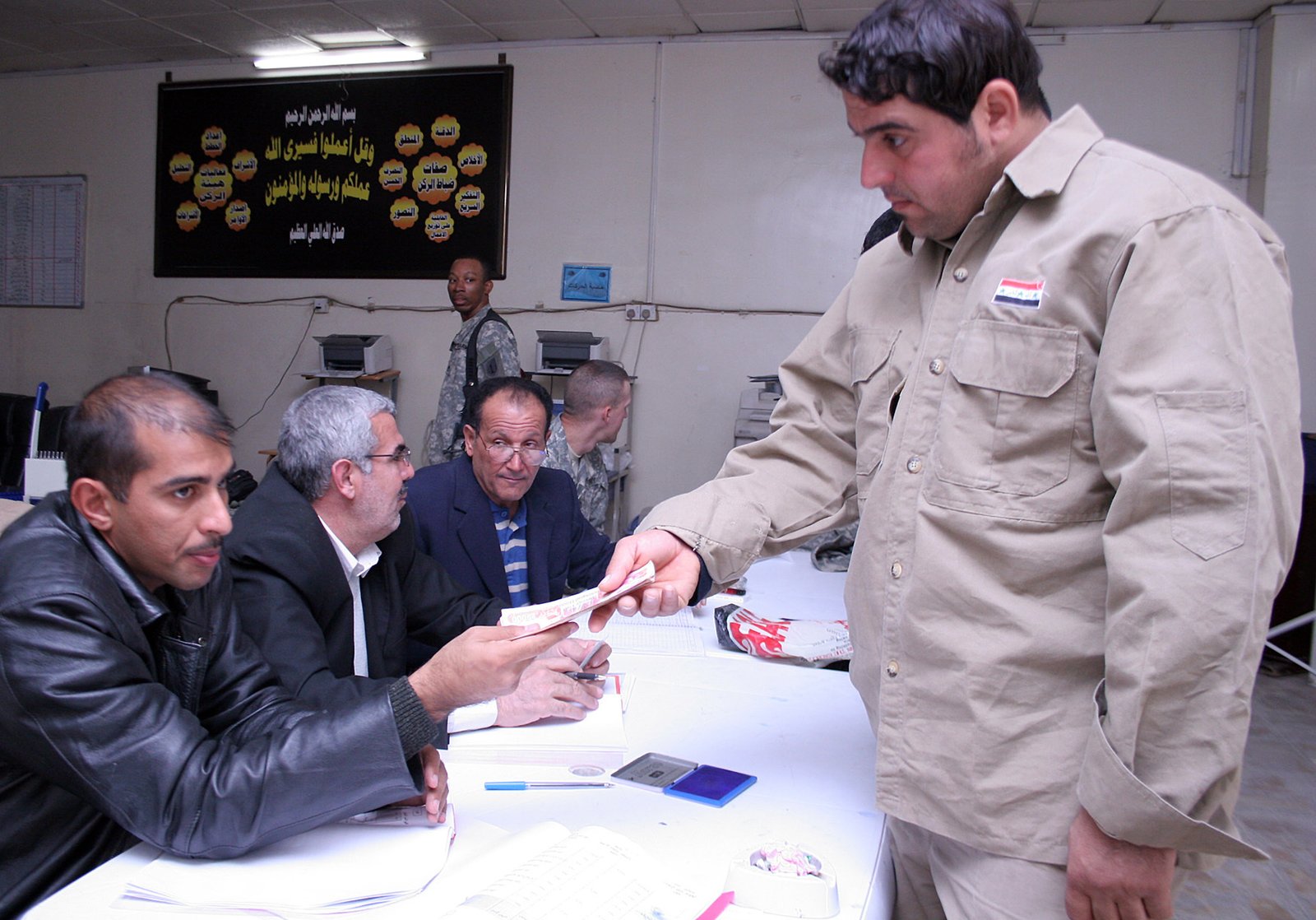
Photo: Government of Iraq follows up initial payments, issues SoI salaries for November by Sgt. 1st Class Matthew Meadows, Public domain