 By
Renault Group plans to hire 1,650 operators at its French plants by 2028 to meet electric vehicle demand, while shedding up to 1,000 white-collar jobs through voluntary departures, according to two people familiar with the matter, as reported by ETHRWorld citing Reuters. The plans were first reported by French newspaper Les Echos.
The job cuts affect the automaker’s entire French industrial footprint, including quality control and supply chain operations, but exclude assembly line workers. The cuts are expected to account for up to 7 percent of a workforce estimated at around 15,000 people. The reorganisation follows the restructuring of Renault’s engineering division, announced last June, which aimed to reduce costs and development times while bringing the group’s performance closer to that of its new Chinese competitors. The new plans still require agreement with unions, a process that has just started.
What the French restructuring signals for Renault’s global footprint
Renault’s move is a classic manufacturing transition: adding direct production roles while trimming indirect salaried positions. The company is also planning a major training initiative comprising nearly 500,000 hours to support staff transitions and adapt the group’s structure to sector challenges, Les Echos reported. For HR teams inside Renault’s operations outside France, including India, the French restructuring is a leading indicator of how the group thinks about workforce mix, cost discipline and skills migration.
Renault has a significant presence in India through Renault Nissan Automotive India Private Ltd, with a plant in Oragadam, Tamil Nadu, and a technology centre in Chennai. While the announced cuts are explicitly limited to French industrial operations, group-level restructuring often influences headcount planning, shared services scope and engineering workload distribution across geographies over time. Indian HR and payroll teams should treat the French announcement as a signal to review local workforce plans, not as a direct instruction.
How voluntary departure programmes work in practice
The French plan relies on voluntary departures rather than compulsory redundancies. In France, this typically involves negotiated collective agreements that set eligibility windows, severance terms and retraining support. Employees who opt in receive exit packages, while the company avoids the legal and reputational costs of forced layoffs. The process requires union agreement, and that consultation has only just begun.
For Indian HR readers, the contrast with Indian law is instructive. Indian labour law does not have a direct equivalent of the French voluntary departure scheme. Employers in India use voluntary retirement schemes under Section 2(s) of the Industrial Disputes Act or negotiated separation agreements, but the legal framework, tax treatment and union dynamics differ substantially. Indian employers considering similar workforce reshaping should confirm the applicable rules with local counsel and ensure compliance with the Industrial Disputes Act, state Shops and Establishments Acts and any applicable standing orders.

Payroll and compliance implications for shared services
Renault operates global business services and shared services centres that support payroll, HR operations and finance across multiple countries. When a group announces a restructuring of this scale, shared services teams in India often absorb additional workload: processing exit settlements, recalculating leave encashment, managing retraining stipends and updating HR systems for organisational changes.
The 500,000 training hours mentioned in the French plan also have payroll implications. In France, training time may be treated as working time and must be paid accordingly. In India, payroll teams supporting French entities need to understand French rules on training pay, social charges and exit taxation. Indian payroll professionals handling cross-border payroll should confirm treatment with the group’s French payroll provider or legal team, as French social security and tax rules differ materially from Indian practice.
What HR teams in India should watch next
The union consultation process in France will determine the final shape of the plan. HR teams in India should monitor three things. First, whether the group announces any reallocation of engineering or supply chain work to lower-cost locations, including India. Second, whether the training initiative creates templates or funding that could extend to Indian operations. Third, whether the restructuring changes the reporting lines or scope of any India-based shared services roles.
The broader context matters too. Sales of EVs in Europe are jumping amid soaring petrol prices since the US and Israel launched attacks on Iran, boosting demand for models like the electric R5 and triggering a shift in production needs across the industry, according to ETHRWorld. That demand shift could accelerate EV-related work in India, where Renault already produces the Kwid and Triber and has announced EV plans for the local market. Indian HR teams should prepare for potential hiring in EV-specific roles, including battery systems, power electronics and software integration.
| Area | France plan detail | India relevance |
|---|---|---|
| Production hiring | 1,650 operators by 2028 | Possible EV production ramp at Oragadam |
| White-collar cuts | Up to 1,000 voluntary departures | Watch for shared services scope changes |
| Training | Nearly 500,000 hours | Template may extend to Indian operations |
| Union process | Just started | No direct Indian equivalent; VRS rules apply |
The key takeaway for Indian HR and payroll leaders is to separate the French legal process from the group’s strategic direction. The voluntary departure scheme is a French mechanism with French legal requirements. The strategic direction, shifting headcount toward EV production and trimming indirect roles, is a group-level signal that may shape planning in India over the next two to three years.
Sources: ETHRWorld
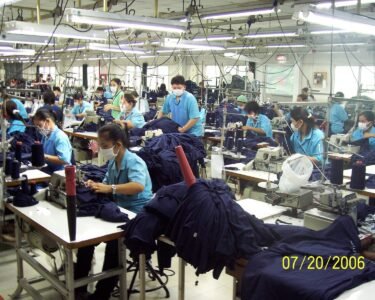
Photo: At an Electric Car Factory in Tianjin, China by Nancy Pelosi, CC BY 2.0