

 By
By Thailand faces a demographic crisis from a rapidly aging population that threatens economic growth, workforce stability, public finances, healthcare, and elderly social protection, according to Devdiscourse. A World Bank report titled Thailand Country Aging Report: A Contract Across Generations , Thailand’s Path to an Age-Ready Society (2026) urges urgent reforms in employment, retirement security, healthcare, and elderly care.
The report, produced with the Thailand Development Research Institute and the Office of the National Economic and Social Development Council, warns that Thailand will become a super-aged society by 2033, when more than 20 percent of the population will be aged 65 or above. People aged 60 and older increased from roughly 4 million in 1994 to more than 14 million in 2024, while the fertility rate has declined to around one child per woman.
The demographic timeline HR teams should track
Thailand officially became an aged society in 2023, when more than 20 percent of the population reached age 60 or older, according to a 2026 commentary in the peer-reviewed journal Inquiry. The same source projects that nearly a quarter of the population will be 65 or older by 2030, and Thailand will become a super-aged society by 2037, defined as 28 percent or more aged 65 or older. The World Bank report cited by Devdiscourse uses a slightly earlier super-aged threshold of 2033 based on the 20 percent aged 65 or above definition.
The working-age population is already shrinking. A 2021 World Bank report found that Thailand’s labor force shrank by more than 1.2 million people between 2012 and 2019. The working-age share of the population is projected to decline from 71 percent in 2020 to 56 percent in 2060, a nearly 30 percent reduction. That would be the third largest decline in East Asia and Pacific after the Republic of Korea and Japan.
| Indicator | Current or baseline | Projection |
|---|---|---|
| Population aged 60+ | 14 million (2024) | Super-aged by 2033 or 2037 |
| Fertility rate | Around 1 child per woman | No reversal projected |
| Working-age share | 71 percent (2020) | 56 percent (2060) |
| Labor force size | 38 million (2019) | Decline of 14.4 million by 2060 |
| Average annual GDP growth | 3.6 percent baseline | 2.4 percent under demographic pressure |
What this means for payroll and workforce planning
The Devdiscourse report highlights a pattern that payroll and HR managers in Thailand already see in practice: many workers leave formal employment before retirement age and move into agriculture, self-employment, or informal occupations with lower earnings and limited social protection. The World Bank’s 2021 data showed that 54 percent of employment was informal in 2019, and agriculture still employed about 33 percent of all workers, compared to 23 percent in the Philippines, 10 percent in Malaysia, and 5 percent in the Republic of Korea.
For employers, this means the formal talent pool is shrinking faster than the overall population. The report recommends flexible retirement arrangements, longer working lives, improved digital skills, lifelong learning programmes, and gradually increasing the formal retirement age towards 65. HR teams should expect pressure to redesign roles for older workers, adjust benefits for phased retirement, and compete for a smaller cohort of formally employed staff.
Women face additional disadvantages because unpaid caregiving responsibilities often force them to withdraw from employment. The World Bank’s earlier research identified the large gap between male and female labor force participation as a potential source of labor supply, but activating it requires childcare and eldercare support that many employers do not currently provide.
Income security and the pension gap
The Devdiscourse figures reveal a stark income problem. Only 46 percent of older adults earn more than 50,000 baht annually, approximately 34 percent have incomes below the national poverty line, and more than 41 percent have savings of less than 50,000 baht. The report recommends increasing the Old Age Allowance, expanding pension coverage for informal workers, and reforming retirement schemes.
Thailand’s tax revenues account for approximately 17 percent of GDP, which constrains how much the government can spend on pensions and healthcare. Age-related public expenditure could rise by more than five percentage points of GDP by 2055. Payroll professionals should monitor whether Thailand introduces mandatory pension contributions for informal workers or raises the retirement age, as either change would affect employer obligations and employee take-home pay.
Healthcare costs and long-term care demand
Thailand has a well-established universal healthcare system, but the World Bank report says medical services remain too focused on treating illnesses rather than preventing them. Noncommunicable diseases including diabetes, cardiovascular disease, hypertension, and cancer account for approximately three-quarters of deaths in Thailand. The economic burden of these diseases was estimated at almost 10 percent of GDP in 2019.
Demand for long-term care is projected to more than double to over 930,000 people by 2040. Families, particularly women, currently provide much of the assistance required by elderly people with disabilities or chronic illnesses. The Inquiry commentary describes elderly care as fragmented across ministries, unevenly implemented, and heavily reliant on unpaid or undertrained community caregivers. It names low utilization of local-level funds, shortages of trained personnel, and weak inter-ministerial coordination across health, welfare, and local government sectors as key gaps.
For employers, rising healthcare costs will flow through insurance premiums and absenteeism. The report recommends stronger disease screening, tobacco control, health education, and community-based healthcare. Companies with older workforces should consider preventive health programmes as a retention and productivity tool, not just a benefit.
Sources: Devdiscourse
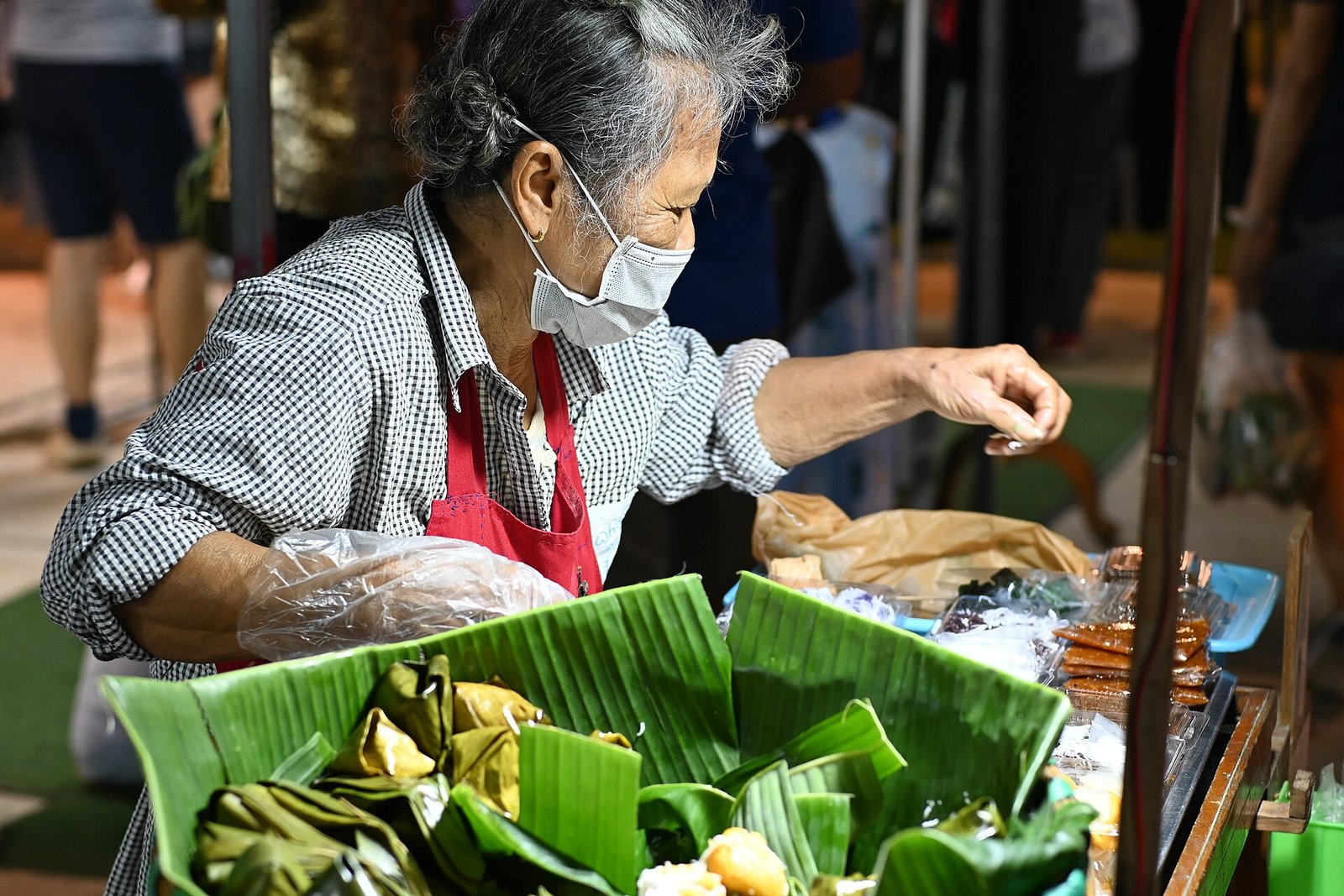
Photo: DFC 4947 An elderly vendor wearing a face mask and gloves arranges traditional s by PattayaPatrol, CC BY-SA 4.0