 By
Egypt’s Minister of Planning and Economic Development, Ahmed Rostom, announced that the government aims to raise GDP growth to 6.8 per cent by fiscal year 2029/2030, up from a starting figure of 5.1 per cent. The targets were set out during a discussion session on the fourth day of the Egypt Forum 2026 on Friday, according to the Egyptian Gazette.
The announcement forms part of the National Economic Transformation Programme, which Rostom said is built on three core pillars: strengthening economic stability and the quality of growth, empowering the private sector, and improving quality of life through decent employment, adequate incomes and enhanced public services. The programme also targets reducing inflation to 7 per cent and lowering unemployment to 5.5 per cent by the same fiscal year.
What the programme actually contains
The National Economic Transformation Programme is structured around three core pillars and four strategic pillars, with 40 targets, 185 key measures, 20 legislative reforms, 25 institutional reforms and 150 performance indicators. Rostom said the government will monitor implementation through those indicators.
Five priority sectors are expected to drive the growth: agriculture, manufacturing, communications and information technology, tourism, and energy. According to the minister, these sectors contributed around 50 per cent of real economic growth, accounted for approximately 40 per cent of GDP, attracted about $3.1 billion in investment inflows during the first half of the 2025/2026 fiscal year, and employed roughly 40 per cent of Egypt’s workforce.
The private sector figures are central to the plan. Rostom said private businesses account for 80 per cent of GDP, 58 per cent of total investment, and 83 per cent of employment, equivalent to around 27 million workers.
Why the jobs target matters for HR and payroll teams
For HR and payroll professionals in Egypt, the unemployment target of 5.5 per cent by fiscal year 2029/2030 translates into a specific hiring environment. The minister’s framing of “decent employment” as a pillar suggests formalisation will be a priority, which has direct consequences for how employers handle contracts, social insurance registration and payroll compliance.
Egypt’s labour market has long been characterised by high informality. The private sector employment figure of 27 million workers cited by Rostom includes a substantial informal component. If the government pushes toward formalisation as part of the quality-of-life pillar, employers should expect closer scrutiny of social insurance enrolment, minimum wage compliance and contract registration. The 20 legislative reforms and 25 institutional reforms in the programme may include changes to labour law or social insurance administration, though the announcement did not specify which laws would change.
Payroll teams should watch for updates from the Ministry of Manpower and the National Social Insurance Authority. The programme’s monitoring through 150 performance indicators suggests reporting requirements could tighten for larger employers, particularly those in the five priority sectors.

The fiscal year timeline and what it means
Egypt’s fiscal year runs from 1 July to 30 June. Fiscal year 2029/2030 therefore covers July 2029 through June 2030. The 6.8 per cent GDP growth target is for that full fiscal year, not a calendar year.
The starting figure of 5.1 per cent cited by Rostom is higher than Egypt’s recent actual growth rates, which have been far below that level in some recent years according to the competitor research. The UNDP source described Egypt’s economy as being in “mitigation mode” in 2023, with a transition to “acceleration mode” expected by 2024-2025. That framing predates the new announcement and does not reflect the updated official targets.
The gap between the 5.1 per cent starting point and the 6.8 per cent target is 1.7 percentage points over roughly four fiscal years. Whether that is achievable depends on factors the announcement did not address, including external shocks, debt service obligations and the pace of private investment.
What happens next
The government said it will launch an interactive map of development projects under the 2027-2030 programme on the ministry’s website and the “Sharek” application. The National Investment Bank will be restructured, with its financial position strengthened and its assets maximised through strategic partnerships after settlement of historical debts.
For employers, the practical steps are to monitor the legislative reform agenda, review social insurance and payroll processes for formalisation readiness, and track which of the 185 key measures affect labour costs or hiring obligations. The five priority sectors are likely to see the most direct policy attention, so HR teams in agriculture, manufacturing, ICT, tourism and energy should follow ministry announcements closely.
Sources: egyptian-gazette
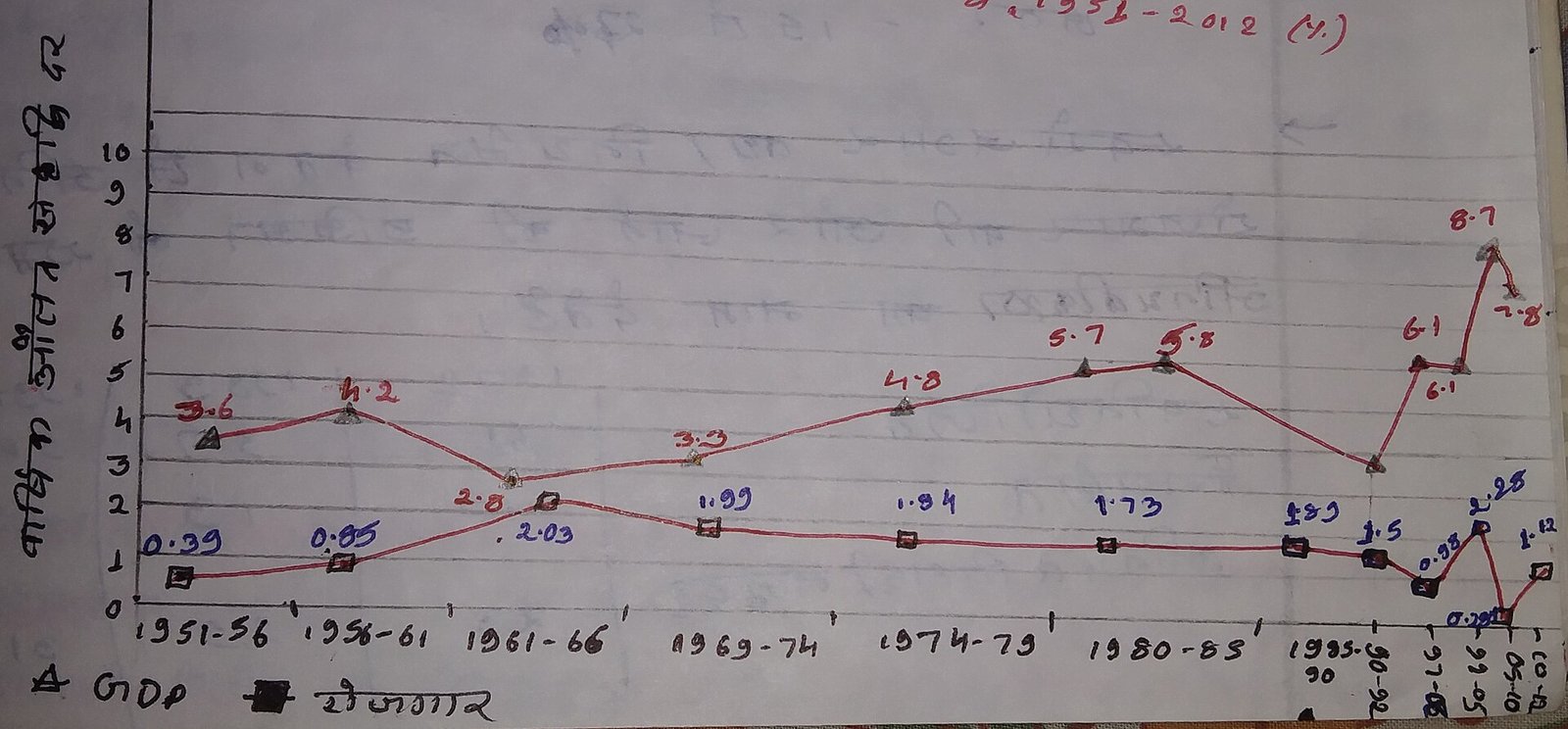
Photo: Growth rate of Indian GDP and employment by शीतल सिन्हा, CC BY-SA 4.0