 By
Singapore’s Ministry of Manpower (MOM) has issued additional guidance for employers on protecting workers from haze exposure, focusing on when to reduce strenuous outdoor work and provide protective equipment. The guidance, reported by Human Resources Online and HRD America, supplements existing recommendations based on the Pollutant Standards Index (PSI) forecast.
Employers should use the PSI forecast to plan outdoor work for the following day, including identifying activities to reduce or reschedule. During the day, employers should use 1-hour PM2.5 readings to adjust outdoor work activities as air quality changes. When the PSI forecast indicates unhealthy air quality, employers should avoid prolonged or strenuous outdoor work for healthy employees. If such work is unavoidable due to extenuating circumstances, masks should be provided.
Minister of State for Manpower Dinesh Vasu Dash said: “The health and safety of our workers must always remain a priority, especially during periods of haze.” He urged employers to stay alert to haze conditions and pay particular attention to workers who are more vulnerable to its effects.
PM2.5 thresholds and required actions
The new guidance sets out four bands based on 1-hour PM2.5 readings, measured in micrograms per cubic metre. At normal levels (0-55), all employees can continue normal activities while employers monitor the haze situation. At elevated levels (56-150), healthy employees should reduce strenuous outdoor work, while vulnerable employees should avoid it entirely. Employers should introduce mechanical aids, job rotation, indoor rest breaks and adequate hydration.
At high levels (151-250), healthy employees should avoid strenuous outdoor work and vulnerable employees should avoid outdoor work altogether. Masks should be provided if strenuous outdoor work cannot be avoided. At very high levels (251 and above), healthy employees should minimise outdoor work and vulnerable employees are prohibited from outdoor work. Employers should defer non-essential jobs, reduce outdoor work intensity and duration, provide masks or respirators if work cannot be avoided, and give hourly indoor rest breaks.
How this differs from the existing PSI framework
The earlier MOM guidelines, published through the Singapore National Employers Federation, used the 24-hour PSI as the reference index. Under that framework, employers should identify employees with chronic heart or lung disease and pregnant employees when the 24-hour PSI exceeds 100. At PSI above 150, strenuous outdoor work should be reduced. At PSI above 200, all strenuous outdoor work for prolonged periods should be avoided, with N95 masks provided if unavoidable. At PSI above 300, employers should consider stopping all outdoor work.
The new guidance adds the 1-hour PM2.5 reading as a more responsive tool for same-day adjustments. The 24-hour PSI reflects average conditions over a full day, which can lag behind rapid deteriorations in air quality. The 1-hour PM2.5 reading captures current particulate levels, allowing employers to make faster decisions about pulling workers indoors or issuing masks. Employers should use both: the PSI forecast for planning ahead, and the 1-hour PM2.5 reading for real-time adjustments.
Practical steps for HR and payroll teams
HR teams should review existing haze management plans against the new thresholds. The guidance asks employers to identify workers more susceptible to haze effects, determine which outdoor work activities should be reduced or rescheduled, and set criteria for restricting outdoor work as haze worsens.
Payroll teams should note that the guidance does not specify whether reduced outdoor work should be paid or unpaid. Employers should confirm their own contractual obligations and consider whether haze-related work stoppages trigger any statutory leave or pay requirements under Singapore’s Employment Act. Where outdoor workers are moved indoors or placed on standby, normal pay practices would typically continue, but employers should document any arrangements clearly.
Employers with outdoor workers should maintain at least a one-week supply of masks as part of haze-related business continuity plans. The earlier MOM guidelines state that N95 masks must be properly fit-tested to be effective, and a one-size-fits-all approach is not acceptable. A simple fit check involves placing both hands over the mask and exhaling sharply to check for air leaks around the seal, then inhaling to confirm the mask collapses slightly.
Vulnerable workers and indoor air quality
The guidance defines vulnerable employees as elderly workers, pregnant women, and those with chronic heart or lung diseases. At elevated PM2.5 levels, these workers should avoid strenuous outdoor work. At high levels, they should avoid outdoor work entirely. At very high levels, they are prohibited from outdoor work.
Indoor workers are not automatically safe. Warehouses, factories and kitchens with open ventilation can experience indoor air quality similar to outdoor conditions. Employers should assess whether indoor spaces have adequate filtration or air purification. Closing windows and doors, running air purifiers with HEPA filters, and relocating vulnerable workers away from loading bays or open doorways are practical measures.
What employers should do next
Employers should review their haze management plans against the new PM2.5 thresholds and update any internal policies that reference only the 24-hour PSI. The PSI forecast and 1-hour PM2.5 readings are available online through the National Environment Agency. Employers should brief supervisors on the new thresholds and ensure they know where to check live readings during the workday.
MOM has not specified a compliance deadline, but the guidance applies whenever haze occurs. Employers who fail to protect workers from known hazards may face enforcement action under the Workplace Safety and Health Act. Employers should confirm their specific obligations with MOM or a qualified adviser.
Sources: HRD America, Human Resources Online
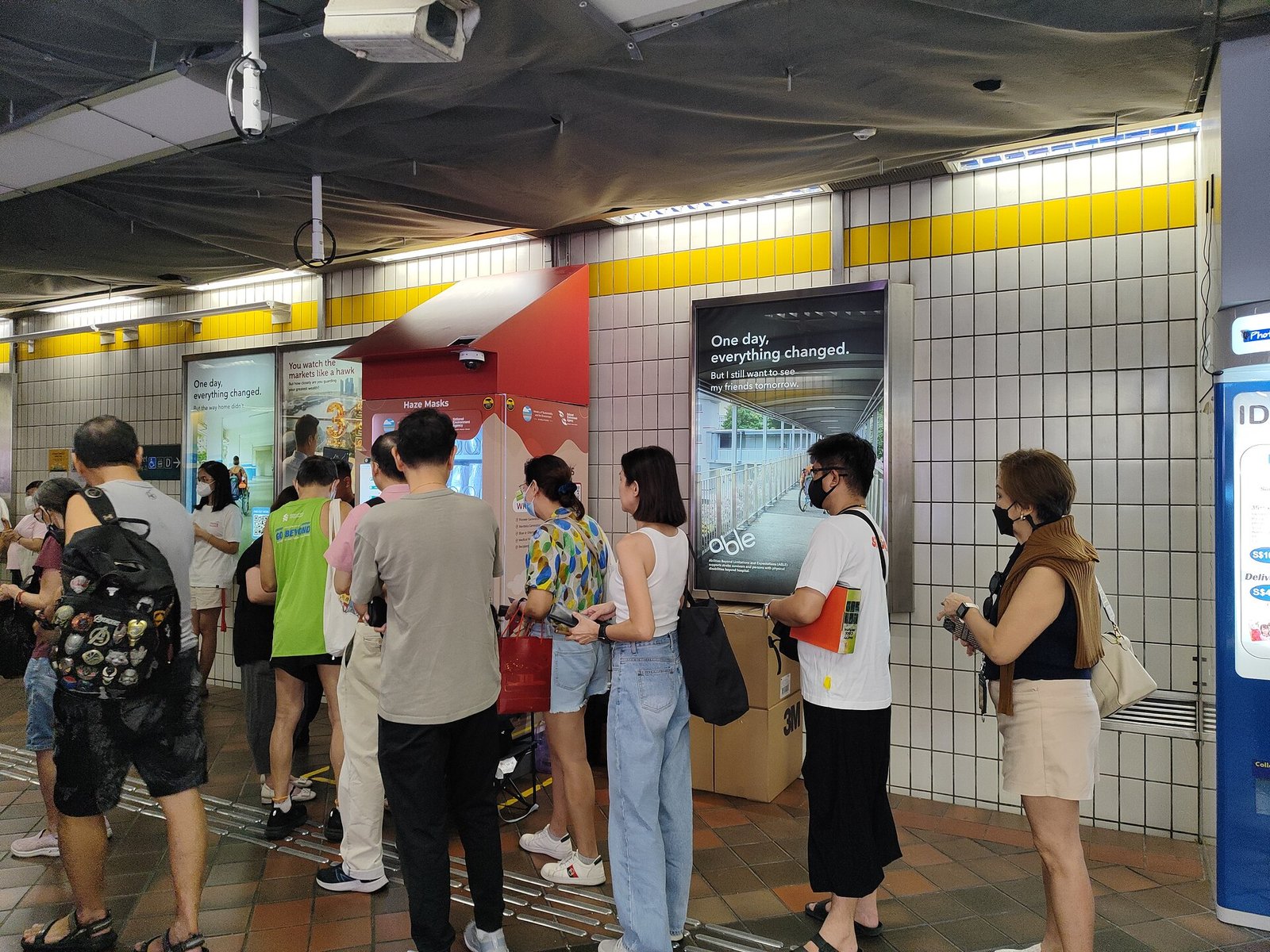
Photo: People queuing for masks during 2026 Haze at Toa Payoh MRT 20261016 180132 by ZKang123, CC BY-SA 4.0